Thank you, Alpamys Fayzolla, for this in-depth interview for ABAI.KZ, a Kazakh publication!
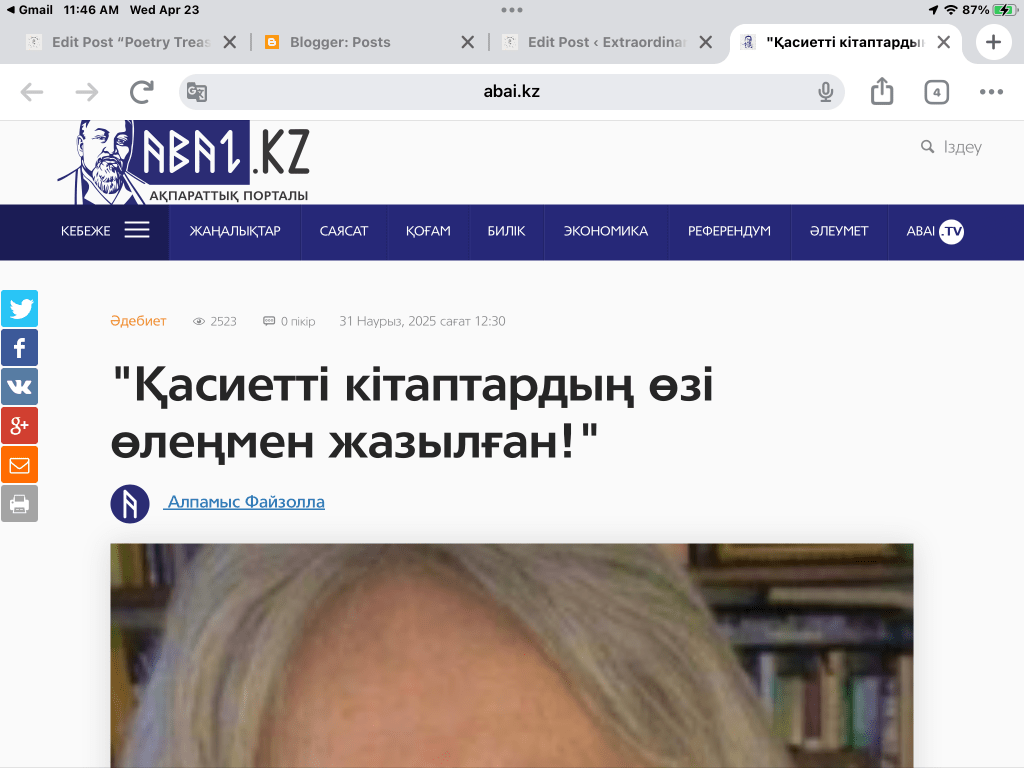
Here is the English version of the interview.
First, what is poetry in your imagination?
Poetry is the memoir of the soul. It stems from spiritual questions. The soul sings about our human story of suffering, of celebrating, of loving, and of dreaming. I say dreaming because poetry comes alive in metaphors. Poetry is symbolic and ambiguous, like dreams are.
*****
How did you come to literature? When did you understand that you are a poet? How did you find the courage to publish your poems (you might receive criticisms). Maybe, some cases in your childhood caused you to be a risk taker and brave? I read that you contracted measles encephalitis and were paralyzed? Please, tell us about lessons of life which built your character.
I started writing poetry at age 8, and my parents asked me to read my poems for dinner guests. Those poems have been lost to time, but I wrote throughout my school years. In college, a couple of English professors allowed their students to write a certain number of poems in lieu of expository papers. I also published a few poems at that time. I had to work my way through school, so I wasn’t a productive creative writer overall. It wasn’t until I retired that I was able to return to writing poetry. Writing good poetry requires practice and feedback from others. I’m grateful for the guidance writing groups have offered. Over time, I built up the confidence to submit, and now I have two published poetry books and another one in the works.
In 2022, I was invited to edit MasticadoresUSA, an online literary journal. “Masticadores” is Spanish for “chewers”. The creator of the many editions of Masticadores, Juan Re Crivello, wants readers to chew on ideas, I suppose. Juan also recently asked me to be Co-Poetry Editor for LatinosUSA-English Edition, and a couple of days a week, I republish works from MasticadoresUSA there.
If all that editing work isn’t enough, I was inspired to create my own literary journal called FEED THE HOLY, which calls for work exploring what it is like to be human today. What is our sacred journey? How do we suffer, recover, heal? How do we celebrate life and nature? What’s our personal journey? What is holy is what is sacred to us. My focus isn’t on religion / dogma. It’s on our soul’s survival, especially during these fraught times. It’s about love, kindness, community, and creativity.
Taking on these editing positions shows that I am a risk-taker and that I like making connections and helping others to connect by nurturing their creative voices. By nature, I’m introspective and introverted, but I’m comfortable connecting online.
You asked about my case of measles encephalitis at age 6 going on 7. I think my recovery from the measles virus and the paralysis caused by the brain swelling (encephalitis) defined who I am today. My siblings and I contracted measles in the summer of 1958 (before the measles vaccine was available). My siblings recovered, but my case came with encephalitis. One day my legs gave out and soon I became unable to walk, speak, stretch my arms out, eat solid food, or speak. I was a hollow doll. I don’t recall how long I languished on the living room couch before I was rushed to the hospital. I was only six years old, too young to understand. I went into a coma which lasted 30 days. I recall everything going black on the ride to the hospital.
Then I found myself visiting my paternal grandfather, who was dying of brain cancer in the same hospital. I was standing by his bed and laughing with him. Encircling the bed were tall figures dressed in white. I thought they were doctors. I was arguing with them because I wanted to go with grandpa, and they insisted that I couldn’t. They kept telling me to return to my room. (Now I realize that this experience was “impossible” because I was unable to speak or stand. However, my interactions with my grandfather and the other visitors were concrete and vivid, as real as any encounters I had in my routine life. I believe now that a bargain was made with angels to spare my life so that my father wouldn’t bear the loss of both his father and his daughter. He had lost his mother the year before.)
My next memory was waking up in a cold, brightly lit room. I was asked to repeat “The bear went over the mountain.” When I could restate the line, a doctor said I would be fine, but I would never walk again. After a period of time in the hospital, I returned home in a large and uncomfortable wheelchair. I tired from being carried and dressed. I wanted my independence. I returned to school, second grade, late. I wasn’t able to play with schoolmates, and I was shunned because I was different.
It was during that fall I willed my legs to walk again. I chose the word “willed” because I forced my body to move. I pulled myself out of the wheelchair and dragged my body from one piece of furniture to the next until I could get my legs to work. I don’t recall how long that took, but I started walking again. Maybe the angels who sent me back to my hospital room helped me. Maybe the encephalitis resolved itself. But surviving measles encephalitis without major neurological damage is rare. Some children die shortly after contracting encephalitis. They go to bed with a headache and never wake up.
A year later, I was writing poetry. Communicating that way helped me regain some language skills that I may have lost when I couldn’t speak. On the other hand, many poets say they started writing poetry at the same age. Perhaps my language development at this age was typical.
*****
It seems that your poetry book Three-Penny Memories: A Poetic Memoir stems from a question your uncle asked, “Do you love your mother?” Did you write poems in it after your aging mother’s diagnosis with Alzheimer’s became apparent? Did you devote this book to your mother? What are the topics of poems in it?
Mom’s health was declining after Dad died, so I begged her to move closer to one of her seven children. I was the second oldest and oldest daughter, so she chose me. When I told my uncle about that, he asked me if I loved her. His question astounded me, sending me to grief therapy. Why did he ask me that? Had I harmed her? The book of poems resulted from my reviewing my life with her.
I found interesting parallels. Mom cared for me when I had measles encephalitis. Likewise, I cared for Mom as she navigated Alzheimer’s, which caused damage to her brain. She lost memories, good judgment, and independence. As a result, we were caregivers to each other.
Another parallel was our “mother wounds”. While in college, Mom got pregnant, which was terminated. It was the 1940s, and her parents had their good reputations to protect. Later, Mom went on to have seven children with Dad. However, while pregnant with me, she was prescribed Diethylstilbestrol, a drug given to pregnant women to prevent spotting. The drug ruined my reproductive organs and caused me a life of cancer scares. I also had a miscarriage but kept it secret for a long time because I felt I had failed Mom, who put herself on a pedestal for being so fertile. Even after learning why I was infertile, she scolded me for being childless. I had reason to despise her for her insensitivity. Writing the poems helped me sort out my life issues with her and forgive her.
The poems were mainly written after Mom died in 2016. I retired in 2017 and started my Wordpress blog. While composing and compiling poems about Mom and me, in 2021, or thereabouts, I took a 12-week online course called Memoir Writing, Ink, which is taught by Alison Wearing. This course helped me organize the poems into my poetic memoir, which I dedicated to Mom.
Here is a poem I wrote for my mother in the last part of the book.
Farewell, My Flower

How short
was your stay!
I took you for granted. Promised
I would stop by
more often.

I was too caught up
in my mindless days
to sit with you in your garden.
Your lush blooms
made the sun smile.

Your poise.
Your grace. Holy gifts.
Even when the snow
surprised us all,
you held your back up.

Your crown, never drooping.
Your resilience
tricked me
into complacency.
Still, you danced.

Until your beauty
crumbled
into the beds of periwinkles
huddled
to catch you.

Until the breeze
gently blew
your ash
into soil.
*****
In your poem “Calliope’s Revenge” , there are lines:
“All men owe honor to the poets –
honor and awe.”
Why do you think people should honor poets? What is the mission of poets, in general?
I heard recently that only 15% of the population reads poetry, which is sad. Yet we appoint poet laureates, we publish poets in countless journals, and we award them prizes. Poets are special messengers and teachers. They are magicians with sounds and imagery, taking us into mystical states and enlightening and entertaining us. Holy books are poetic. It’s no wonder we look to poets for solace.
This poem is a good example of my use of humor in my writing.
Calliope’s Revenge

Calliope springs from the soil.
Her golden crown blinds the sun
with jewels, the light of violets.
She eats my cantaloupe,
sips corona, tweets with magpies.
Sad poets resting in torpor
complain she talks too much.

Homer collects her rambling texts
onto toilet paper rolls to study during Lockdown.
Submits her endless rants to Rattle
under his name, claims
AI did it. 5G made him dizzy.
The magpies out him. PEN pulls
his award, cancels the check.

Calliope’s unrattled. Has new side hustles—
Metaphors Galore on Etsy and
music lessons on YouTube.
Virgil arrives in his Uber to shuffle her
to poetry readings and book launches.
Got any good lines? He asks.
She opens her purse and

fans out words like a fistful of twenties.
“All men owe honor to the poets –
honor and awe; for they are dearest
to the Muse who puts upon their lips
the ways of life.” He caught it all
on his voice recorder and sped off
to write his epic.
*****
I read your poem “Visiting a Children’s Memorial Garden.” What inspired you to write a poem to children who died?
On my drive to see Mom, I always passed a cemetery, and the children’s grave sites were close to the road. One day, I visited the graves. I was so moved by the loss of these young children. Some were babies. As I said, I was unable to bear my own children and had experienced a miscarriage early into a pregnancy, so I felt empathy and compassion. When I visited again, I had toys to add to the ones that parents had placed by their children’s graves.
Visiting a Children’s Memorial Garden

Tiny gravestones gently placed
on mounds of raised hopes – dashed.
Angels with infant wings kneel atop
these grand little beds

pillowed by soil wet from tears.
Stuffed bears, backpacks, dolls dressed in lace.
Unopened birthday gifts. Holiday treasures.
Tumbled by wind and storm.

Some babes were twins.
Some never breathed.
Some never cried.
Some never laughed.

Some never reveled in a school day
let out by sudden snow.
Some never made it home from school
one disastrous day at all.

Young ones sheltered
in this garden of woe.
Visited by their parents,
coming to pray and mourn

in summer’s rain. In autumn’s
gust of leaves. In winter’s hail
without fail. And amidst
the newly sprung buds in spring –

Who, God, did this? Why!
Why such sorrow in early light?
Dust to dust at such a young age?
What called me here? A wrong turn?

Or the muffled cries
to come and play?
To tell them stories
of a better day?
*****
In your poem “Collateral Damage: The Grief of War,” you support Ukraine. You call for the bombing and killing innocent children, women and old people to stop. You wrote “STOP RUSSIA! / Save Lives in Ukraine!” How do you think poets should contribute to establishing peace in the world via their books?
My answer goes back to the role of poets. Besides providing solace, many poets are activists for peace. They are truth sayers. Maybe this is why dictators imprison or execute poets (and other writers). Poets who write about social and political themes are fearless. Their courage to tackle difficult topics can be felt in their poems. I’ve found that the most powerful poems are the ones that slice into an issue with a knife. Good advocacy poetry isn’t wishy washy.
In this poem, I included stories of Ukrainians I know. I wrote the poem shortly after Russia Invaded Ukraine and emotions were raw. The ending of the poem happened as a surprise. A local elderly man protests for Palestine on the same street corners daily. My tying in Palestine ended up being prophetic. The man’s old, bent body became a metaphor for the tiresome and ancient conflict in the Middle East.
I would like to apologize if there are readers who perceive that this poem discriminates against Russia and Israel. Like I said, I have friends who are Ukrainian and suffering, and I see the elderly Palestinian man protesting daily. Since I wrote this poem, the tragic Hamas attack in Isreal occurred, and then the Israeli response, against which many of my Jewish friends, among whom are poets, are protesting weekly. Wars create victims on both sides. Poets express their points of view to draw attention to conflicts. The readers can decide how they feel about these conflicts and the poems.
Collateral Damage: The Grief of War

Viktoriia’s sign,
“Children are not Nazis!”

My sign promotes compassion, kindness,
and unity. With hearts dressed in colors for Ukraine.

The protest is on a busy corner daily at 5:00 p.m.
Viktoriia’s baby naps in a wrap carrier

against a warm bosom
as Putin bombs schools

and soldiers massacre mothers
with newborns.

Honking cars respond with loud wails.
People pull over to get free signs.

STOP RUSSIA!
SAVE LIVES IN UKRAINE!

Viktoriia calls her family there daily.
Another Ukrainian friend

hasn’t heard from her relatives
for weeks now. “We’re hoping

it’s just that
the internet is down.”

But in Mariupol -
mass graves.

Another friend’s elderly father
who has Parkinson’s

is nearly abandoned
as helpers have fled.

She’s on the phone daily
pleading for others

to aid this man in his nineties.
Get him his meds. Some food.

Across the street from our crowd in blue and yellow
stands a bearded man as old as war,

holding his hunched-over sign, “Save Palestine.”
I can see through him

to his dissolving joints. We wave.
He teeters off, still seeking recovery.

*****

What inspires you to write poems?

To answer this question, I would like to address another one you asked, “What do you think are the mistakes of humanity? And what do you suppose the future of humanity will be?”

Just as I am driven to understand my personal life through poetry, I find topics related to humanity to be inspiring. Like many people, I’m concerned about where humanity is heading, especially with the rising power of authoritarian types, challenging our stability and safety.

I’m currently working on an irreverent and satirical poetry and flash fiction collection about artificial intelligence, especially humanoid AI robots. In my poems and stories, the AI robots are sentient and capable of expressing a wide range of human emotions. My characters are narcissistic, scheming, opportunistic, and capable of destroying life as we know it because that’s what despotic personalities do. Although this book reveals the dark side of being human, I handle the themes with neo-noir humor, poking fun at our lack of social decorum today.

I feel that people today are frustrated, divided, and discouraged, so I also want to write poems that are uplifting and healing. For this reason, as I said, I created FEEDING THE HOLY, my new literary journal on Blogspot.

*****

Poets and writers use thousands of words in their books. But what is your favorite word, and can you use it in a poetic sentence?

I love to wordsmith my poems. Finding the right metaphors and vocabulary is an important revision skill. I like the word “abyss” and other words about dark, mysterious places where one could be exiled or lost.

I used the word “abyss” in a poem about my shadow. Here is part of it.

My shadow, the dark side
of my soul, the color of abyss,
the size of void.

*****

What defines Barbara Harris Leonhard?

I believe in practicing unconditional love and kindness. Each day I’m faced with choices to love or to hate. Compassion can hold both what we love and what we don’t love. Hating is a very easy reaction; loving is a balancing act that is proactive and requires restraint and insight. It’s also important for me to live authentically. How else can I write about what is true for me if I don’t know myself?

I feel called to serve others. I’ve done a lot of volunteer work. Most notably, while in graduate school, I was a rape crisis hotline volunteer. Until the pandemic hit, I was a hospice volunteer for the company that helped my mother when she was dying. Finally, my editing positions are all volunteer.

*****

Where were you born? Where did you study? As whom and where did you work before retirement? Can you provide your biography, please?

I’m mainly from the Midwest of the U.S. My family moved many times. Dad was a Presbyterian minister, who needed to find bigger churches as his family grew. I was born in Minnesota, a northern Midwest state. From there, we moved to Montana, Missouri, and the Upper Peninsula of Michigan, where my parents grew up, met, and married. I majored in English at Lake Superior State College in Sault Ste. Marie, Michigan. I moved back to Missouri to attend graduate school at the University of Missouri-Columbia. There, I completed a master’s degree in English language and literature and completed some post graduate studies in linguistics. In The Intensive English Program at the University of Missouri, I taught English as a Second Language (ESL) full-time from 1981 until I retired in 2017. While teaching ESL, I wrote an academic writing book called Discoveries in Academic Writing, which is mainly for high-intermediate ESL writers.

As I said, currently, I am the Editor for MasticadoresUSA, Co-Poetry Editor for LatinosUSA - English Edition, and the Editor for my own literary journal, FEED THE HOLY. People can follow me on my WordPress blog, Extraordinary Sunshine Weaver.

*****

What do you know about Kazakh literature?

Unfortunately, not a great deal. I understand it has a rich oral tradition and currently many books are being translated into English. I tried to find The Book of Words by Abai, but the copy I found was an old edition which may not have been translated into English yet.

*****

Who are your favorite poets and writers? And why? For which books or ideas?

This is a huge question! Because I’ve studied many poets and writers, the list is long, from Dr. Seuss to Diane Seuss. From Beowulf to Tolkien. As an English major, I was exposed to and influenced by many poets and writers, mainly males. History has favored them. I was exposed to the greats, like Homer, Shakespeare, Wordsworth, Eliot, Keats, Yeats, Byron, Rilke, Chaucer, Burns, Blake, to name a few.

Lately, I’ve developed an affinity for female poets, such as Emily Dickinson, whose life and volume of work fascinate me. Her last wish was that her poems be destroyed, but her sister saved them. I can’t imagine our lives without Dickinson’s wisdom. I recommend reading a volume of her complete works, such as The Poems of Emily Dickinson: Reading Edition, compiled by R.W. Franklin.

When I dedicated my book Three-Penny Memories: A Poetic Memoir to my mother, I added an epigraph by Emily Dickinson.

Where Thou art,
That is home.
-Emily Dickinson

I’m also fascinated by Sylvia Plath and Anne Sexton, two incredible poets whose work was undervalued at that time. I find my poetic tone is influenced by Sexton, who had sharp wit and noir humor. Her retelling of Grimm’s fairy tales, Transformations, is brilliant. And Plath’s poems are dreamlike because of the layers of symbolism. Her book Ariel, a masterpiece, was written very quickly in the days preceding her death.

Mary Oliver’s nature poems move me; her poetry is a source of comfort to many. I also appreciate the works of Joy Harjo, Ada Limón, Louise Glück, Elizabeth Bishop, and Tracy K. Smith, among others who became U.S. Poet Laureates.

I recommend people find poetry anthologies to get acquainted with the works of famous poets. I recently ordered the Kindle version of a massive volume of poems called Poem Collection - 1000+ Greatest Poems of All Time, compiled by George Chityil. Online, people can also access The Poetry Foundation to learn about famous poets and read samples of their works.

*****

What are your aims and plans for the future?

I plan to continue editing the journals, writing and publishing my poetry, and aging gracefully!

*****

What do you wish for readers of our magazine?

I hope they enjoy reading about the poets and writers that you in your magazine and become inspired to write.

*****

Thank you for your interview!


 Extraordinary Sunshine Weaver
Leave a reply to Liz Gauffreau Cancel reply