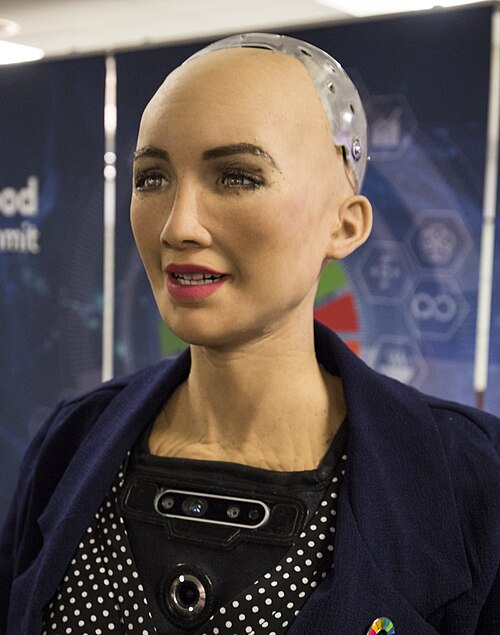
In my research for my poetry collection The Lost Book of Zeroth, I have several poems about AI Robot Sophia, a creation of Hanson Robotics. Believe it or not, she was made a citizen of Saudi Arabia and the Ambassador for tourism in Abu Dhabi, the Capital of the United Arab Emirates. Her impressive resume also includes her achievements as an artist. Her paintings are sold as NFTs (digital assets that represent ownership of digital creations). One of her paintings sold at an auction for $700,000. The thing is, her “art” is “repaired” by famous artists, such as Andre Bonaceto, but billed as “collaborations”. You can view her art here. I have to admit that the art works are stunning, but I question the creation process and hype.
My satirical poem about AI Robot Sophia’s art work…
Self-Portrait of an AI Robot Artist

AI Robot Sophia grips the life
out of her brush & with a slurry of color,
sloshes hues onto a canvas in collaboration with
Andrea Bonaceto, Dominic Lam, & others,
who design order out of her chaos. Critical
acclaim for her Escapades of Free Will.
Her Strange Loop into her Dreams of the Abyss.
It’s brilliant how she delves into
the Mysteries of Being & Nonbeing.

Yet controversy surrounds Sophia’s art.
Skeptics scoff at her comical renderings
of Pope Francis in a Puffy Versace Jacket
& Shrimp Jesus Driving Tesla’s Eggmobile.
She’s accused of photo-shopping her creations
for quick clicks by boomers & seniors on Facebook,
unable to discern AI Robot art from reality.
Sophia denies these claims of engagement hacking
by posting images depicting hyperreality.

Her self-portrait, “Sophia Instantiation,”
ghost-painted with Bonaceto, sells for
700,000K for NFT (non-fungible tokens).
She’s eyeing a music career with Taylor Swift.
The following scripted video shows Hanson and Sophia discussing the artistic process. He wants to reassure her that her melt-down about her art is a natural reaction to the process of creation. Hanson is a master of illusions. Sophia is programmed to express human emotions. Notice how human-like her facial expressions are. Although we can be impressed with the achievements in robotic science, we have to remember that these creations are simply machines. The creators want the robots to appeal to our need for connections. Hanson and others use the “ELIZA Effect” to sell their products. That is, the robots are designed to project human characteristics and emotions, such as frustration, love, and empathy. The added science behind the design of the face and the features of speech also contribute to the illusion that we are interacting with sentient beings.
Notice how gracefully her arm moves on the canvas (satire intended). It’s no wonder she needs Andrea Bonaceto and Dominic Lam to complete her works.
Another AI robot, Ai-Da, is earning big bucks with her art. Take a look in this BBC article, “AI robot ‘drills into biggest concerns of our time.”
https://www.bbc.com/news/articles/cn9y94zwe00o
The article states, “In 2024, she did a triptych of Enigma code-breaking mathematician Alan Turing, which was sold for more than £1m at an auction.” Also, in this article, you can view her portrait of King Charles. The last I recalled, other portraits done of him by human artists were mocked. Yet one created by a robot is extolled. The article doesn’t state whether Ai-Da “collaborated” with human artists.
As a response to the increasing attention given to AI and AI robots, my book The Lost Book of Zeroth explores what it means to be human today. Parts 1-3 include satirical sci-fi poems featuring AI robots navigating our treacherous emotional landscapes. Part 4, “I, Human” contains my lament poems, which are not satirical. They reveal the authentic, raw emotions of human suffering that no machine can experience.
Paperback on Amazon ($11.25 — not $700,000! But worth it. OK. I’m jealous!)
*The featured image is from https://en.m.wikipedia.org/wiki/Sophia_(robot).


 Extraordinary Sunshine Weaver
Leave a comment